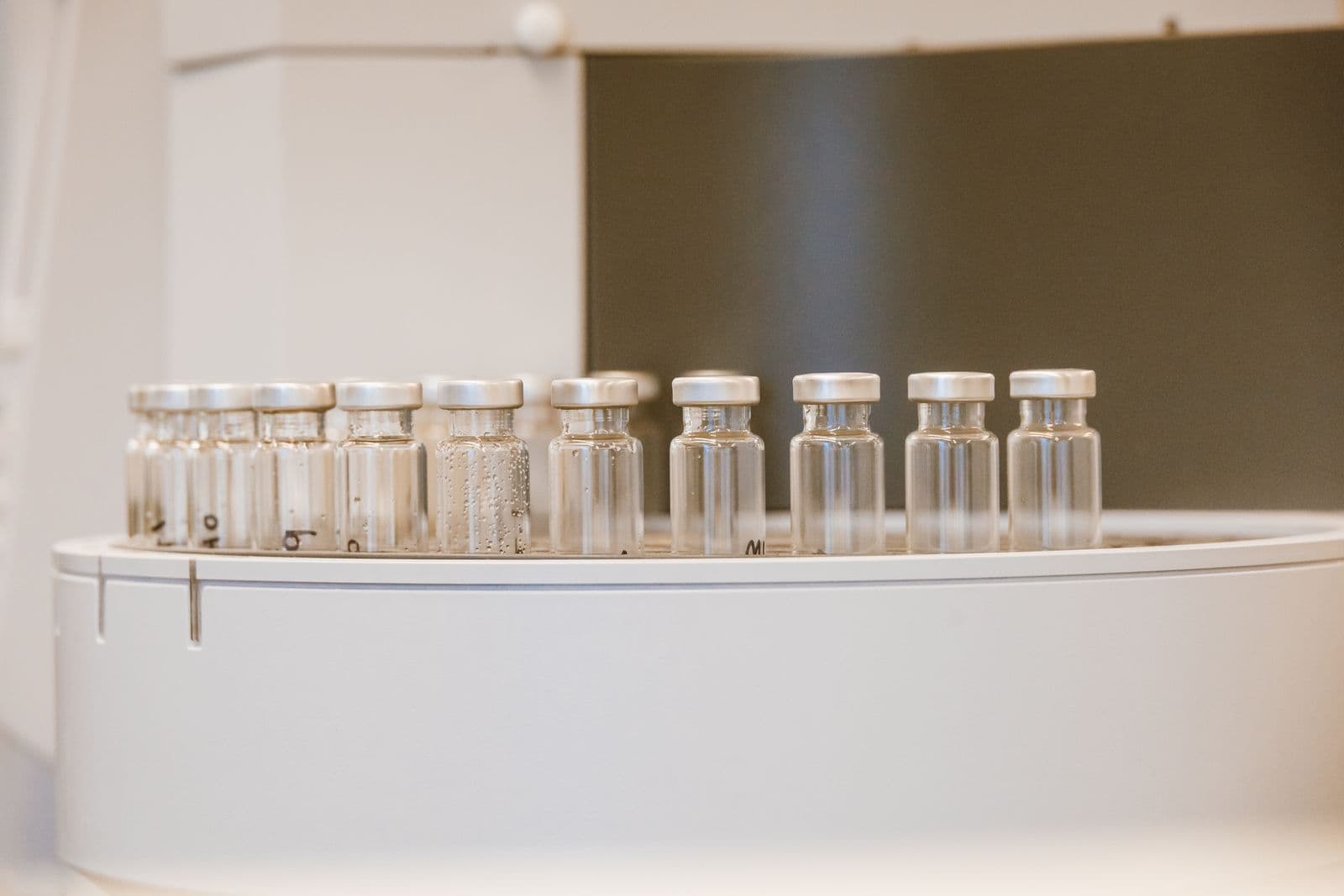
PlatinumLongevity.co sells tesamorelin for laboratory research use only. This page summarizes the published literature. It is not guidance for human use.
What it is
Tesamorelin is a synthetic analog of human growth hormone-releasing factor, also called GHRH. It keeps the 44-amino-acid sequence of the human hormone. A trans-3-hexenoyl group is attached to the tyrosine at the N-terminus. The free base has the formula C221H366N72O67S and a molecular weight of 5135.9 Da (Egrifta WR label).
PubChem lists CAS number 218949-48-5 (PubChem). FDA lists Theratechnologies as holder of the former new drug application 022505. FDA gives its initial approval date as November 10, 2010 (FDA list).
What has been studied
Tesamorelin has more human trial data than the other peptides in this series. Most trials enrolled adults with HIV.
| Study | Study type | Size |
|---|---|---|
| Falutz et al., 2007 | Human, randomized, placebo-controlled, 26 weeks | 412 patients |
| Falutz et al., 2010 | Pooled analysis of two phase 3 trials with extension | 806 patients |
| Stanley et al., 2019 | Human, randomized, double-blind, 12 months | 61 patients |
| Ellis et al., 2025 | Human, phase 2, randomized, open-label, 6 months | 73 participants |
Visceral adipose tissue in HIV
The first phase 3 trial randomized 412 adults with HIV and abdominal fat accumulation, 86% of them men. Over 26 weeks, visceral adipose tissue fell 15.2% with tesamorelin and rose 5.0% with placebo. Triglycerides fell by 50 mg per deciliter on tesamorelin and rose by 9 on placebo. The ratio of total to HDL cholesterol fell by 0.31 against a rise of 0.21. IGF-I rose 81%. Adverse events did not differ significantly, but more tesamorelin patients withdrew because of one (Falutz et al., 2007).
A pooled analysis of two phase 3 trials covered 806 patients. Abdominal subcutaneous fat did not change significantly at 26 weeks. The visceral fat reduction held through 52 weeks in patients who stayed on tesamorelin. The authors reported no clinically meaningful change in glucose measures at 26 or 52 weeks (Falutz et al., 2010).
Liver fat in HIV
A trial in people with HIV and fatty liver disease enrolled 61 patients. After 12 months, liver fat fraction fell by 4.1 percentage points more with tesamorelin than with placebo. Local site complaints were more common in the tesamorelin group, though none were judged serious. At 12 months, 35% of the tesamorelin group and 4% of the placebo group had liver fat below 5% (Stanley et al., 2019).
Cognition
A phase 2 open-label trial randomized 73 people with HIV and abdominal obesity. Tesamorelin reduced waist circumference more than standard care. The difference in neurocognitive performance between groups was not significant. IGF-1 rose, but its change did not track cognitive scores or waist size (Ellis et al., 2025).
Regulatory status in the US, October 2026
- Tesamorelin is approved by the FDA as Egrifta. The current Egrifta WR label says it is indicated to reduce excess abdominal fat in adults with HIV and lipodystrophy (DailyMed).
- The label lists limits of use. Long-term cardiovascular safety has not been established. The label also says it is not indicated for managing body weight.
- On March 23, 2020, FDA deemed the Egrifta application a biologics license (FDA list).
- FDA has said these transitioning biological products are not eligible for the 503A and 503B compounding exemptions (FDA notice).
On August 24, 2026, FDA sent a warning letter to NuScience Peptides LLC. It named "Tesamorelin Research Peptide" and a tesamorelin blend among unapproved new drugs. FDA said website evidence showed the products were intended for human use, despite "research use" labels (FDA warning letter).
What is unknown or contested
- Cardiovascular outcomes. The label states that long-term cardiovascular safety has not been established.
- Populations outside HIV. The approved indication and the trials summarized here involve people with HIV. Results may not carry over to other groups.
- Liver outcomes. The 2019 trial authors wrote that further studies are needed on long-term effects on liver histology.
- Cognition. The 2025 trial found no clear benefit. Its authors note limited power and no placebo arm.
- Contraindications. The label lists active malignancy, pregnancy, and disruption of the hypothalamic-pituitary axis, among others.
Handling notes for a lab
Two published sources describe storage, and they cover different materials.
The Egrifta WR label covers the finished drug product. It lists the unopened vial at 20°C to 25°C, in the original box to protect it from light, and says not to freeze (DailyMed).
Cayman Chemical supplies research-grade tesamorelin acetate as a solid. Its sheet lists storage at -20°C and stability of at least four years. It reports that the solid is sparingly soluble in PBS, and it does not recommend storing aqueous solutions for more than one day (Cayman Chemical). Follow the certificate of analysis for your lot.
Lot documentation and specifications are on the product page, Tesamorelin at PlatinumLongevity.co.
Sources
- DailyMed, Egrifta WR (tesamorelin) label
- PubChem, tesamorelin (CID 16137828)
- FDA, approved NDAs for biological products deemed BLAs, 2020
- FDA, notice to compounders on March 23, 2020 changes
- Falutz et al., N Engl J Med, 2007
- Falutz et al., J Clin Endocrinol Metab, 2010
- Stanley et al., Lancet HIV, 2019
- Ellis et al., J Infect Dis, 2025
- FDA warning letter, NuScience Peptides LLC, August 2026
- Cayman Chemical, Tesamorelin (acetate) product sheet
For laboratory research use only. Not for human or animal use. Nothing on this page is medical advice.